
0
Success in a Tongits online game often starts with reading the opening hand correctly. A “strong” deal seldom means collecting the most face cards or receiving a near-finished combo. Hand strength comes from how smoothly the cards can turn into valid melds, how many practical ways the hand can improve after a few draws, and how risky the deadwood becomes if the round ends earlier than planned.
New players tend to benefit from a clear way to judge which cards deserve to stay and which ones should be discarded quickly. Seasoned players also gain an edge by focusing on hand structure rather than being tempted by high values that do not connect. Card relationships matter most: completed melds, workable connectors, point-heavy leftovers, and room to adjust as opponents reveal information through discards.

Quick Answer: What makes a starting hand strong in Tongits?
A strong Tongits starting hand features at least one completed set or run, extra cards that can realistically become additional melds, and minimal unmatched high-value cards. A flexible hand—one that can shift plans based on draws and discards—tends to outperform a hand that relies on a single hoped-for card.
Basics to remember about Tongits starting hands
Traditional Tongits is played by three people using a standard 52-card deck with no jokers. At the deal, the dealer holds 13 cards and the other two players hold 12 each. The remaining cards form the stock pile for drawing throughout the round.
The goal is to create melds while keeping unmatched card points low. Two meld types define Tongits:
- Set: three or four cards of the same rank, such as Q♣-Q♦-Q♠
- Run: three or more consecutive cards of the same suit, such as 6♥-7♥-8♥
In many Tongits rules, the Ace functions as low. A-Q-K of the same suit looks connected but does not count as a valid run. Accurate knowledge of what qualifies as a meld prevents early misplays.
Starting hands with completed melds: the strongest foundation
A completed meld immediately strengthens an opening hand by reducing deadwood and giving a stable base to build from. A ready-made run like 6♥-7♥-8♥ can support future extensions, and a set such as three 9s locks in an instant combination.
Even with a made meld, the rest of the hand still matters. A single meld does not automatically produce a strong overall position if the remaining cards are disconnected and point-heavy.
A key evaluation rule also applies: one card cannot be counted in two melds at the same time. A 7♥ used in a 6♥-7♥-8♥ run cannot also serve inside a three-7 set simultaneously. Opening hands that appear “loaded” can be less effective once overlaps are removed.
Near-melds that signal real potential
Tongits hands often win through development, not just through the initial deal. Near-melds—two-card blocks that can become a set or run—can be valuable when completion odds are realistic.
Common examples include:
- Two suited connectors: 4♦-5♦, which can become a run by drawing 3♦ or 6♦
- A pair: K♠-K♦, which can become a set if another King appears
Not every near-meld provides the same return. Two consecutive suited cards typically offer two immediate route cards. A pair usually requires one specific rank, which can take longer to appear.
High-value unmatched cards and deadwood risk
Starting-hand strength also depends on what remains outside your meld plans. Typical Tongits scoring assigns 1 point to Aces, face value to number cards, and 10 points to Jacks, Queens, and Kings.
High-value cards can become liabilities when they sit unmatched. A K-Q-J group with no current meld connection can represent 30 deadwood points if the round ends suddenly through a draw or another ending trigger.
Discard strategy becomes a balancing act. A high card that supports a likely set or a strong suited run path can be worth holding. A face card with no realistic connection often becomes an unnecessary risk, especially when safer discards exist.
Flexibility: a major marker of a premium opening hand
A strong starting hand usually offers more than one way to improve. Holding 7♣-8♣ provides two natural completion options—6♣ or 9♣—which is more flexible than holding unrelated cards that rely on one exact draw.
Flexibility also includes the ability to abandon a plan. If the table reveals that your needed connectors are being discarded, continuing to protect a weak builder may create deadwood and slow your hand progress.
Deadwood check: quantity and total points
Deadwood refers to cards not included in valid melds. Managing unmatched cards matters because their total point value can decide outcomes in sudden endings. Several opening patterns help guide evaluation:
- Completed three-card run: strong, already a meld
- Three of the same rank: strong, immediate set
- Two suited consecutive cards: promising, needs a connector
- Two matching ranks: promising, needs one more of that rank
- Multiple disconnected face cards: risky, high deadwood exposure
- Mostly unrelated low cards: limited, fewer realistic combinations
Low cards alone do not guarantee strength. A hand filled with small numbers but no connections can still struggle to form melds quickly.
Example: comparing two starting hands
Hand A: 6♥, 7♥, 8♥, 5♣, 5♦, K♠, Q♦, 4♣, 9♣, 2♥, J♦, 3♠
Hand B: 2♠, 7♥, 9♦, J♣, Q♠, K♦, 4♥, 8♦, 3♣, 10♠, A♠, 6♣
Hand A begins with an immediate run and includes a pair of 5s that can develop into a set. Hand B lacks a completed meld and carries three face cards worth 30 points if left unmatched, though it does have possible builders such as A♠-2♠ and 8♦-9♦. The contrast highlights why structure plus deadwood provides a clearer assessment than counting “big cards.”
Five-step method for evaluating an opening hand
- Identify completed sets and runs
- Mark potential combinations (pairs and suited connectors)
- Separate cards that remain unmatched
- Calculate total unmatched points for deadwood exposure
- Track availability by watching exposed cards and discards
Common starting-hand evaluation mistakes
Misjudgments often come from treating pairs as finished melds, keeping face cards without a plan, ignoring suit-based connections, focusing on single card values instead of total deadwood, failing to adjust as discards change the odds, and assuming a good start guarantees the round.
Applying starting-hand reading to Tongits GameZone
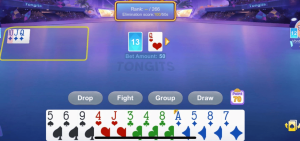
Tongits GameZone players can apply the same evaluation fundamentals in online play: prioritize made melds, favor flexible builders, limit deadwood points, and reassess plans based on opponents’ discards. Tongits Plus typically follows the 52-card, three-player format, while also featuring platform-specific rules and ending conditions. Checking the latest in-app guidelines helps ensure card evaluation matches the current scoring and round mechanics.

FAQs
How many starting cards are dealt?
Dealer: 13 cards; other players: 12 cards each in the standard three-player setup.
How do discards affect starting-hand plans?
Visible discards can reduce the likelihood of completing certain runs or sets.
Are multiple pairs better than one completed meld?
Not necessarily; a completed meld is immediate value, while pairs remain only potential.